In 2025, SSE Group conducted its first Double Materiality Assessment. Not as a compliance exercise, but as a strategic discipline guiding how sustainability priorities are integrated into decisionmaking.
As RESONANCE evolves from ambition to structured execution, we asked a simple but fundamental question:
Where does sustainability matter most — both for SSE’s impact on society and for the long-term resilience of our business? The Double Materiality Assessment provides a clear, evidence-based answer.
Structured Dialogue Across Our Ecosystem
The assessment was built through a structured dialogue across SSE’s ecosystem. The process began with a strategic workshop bringing together 12 senior leaders and a shareholder representative, who identified an initial set of 16 sustainability topics based on SSE’s business model and strategic exposure.
The assessment was then expanded toinclude:
- 40 employees across business units and functions
- 17 external stakeholders, including customers, suppliers, regulators, ESG experts and community representatives
This layered approach ensured that operational realities, strategic oversight and external expectations were fully reflected in the assessment. Each topic was evaluated through two complementary lenses:
- Impact materiality
How SSE’s activities affect people, society and the environment. - Financial materiality
How sustainability factors influence SSE’s financial performance, risk exposure and long-term competitiveness.y.
By combining these perspectives, the Double Materiality Assessment transforms sustainability insights into a structured decision framework supporting governance and strategy.
DOUBLE MATERIALITY MATRIX SSE GROUP STAKEHOLDERS (INTERNAL-LEADERSHIP-EXTERNAL)
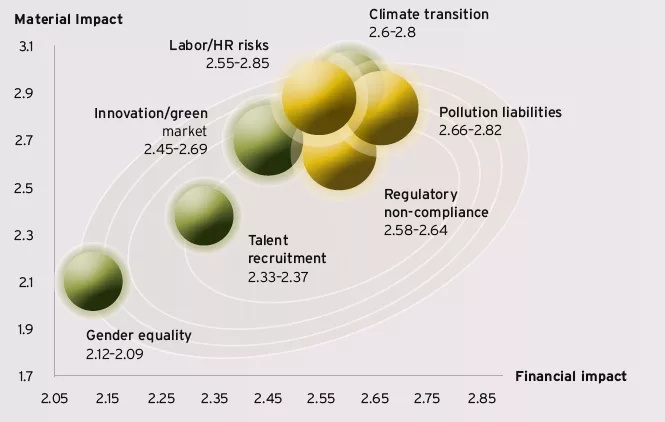
X-axis: Financial importance
Y-axis: Impact significance (people & environment)
Bubble size: Intensity of perceived risks & opportunities
 Opportunity-driven topics
 Risk-driven topics
Score ranges: Min-max values across employee & leadership ratings
The DMA confirms the strategic relevance of all five RESONANCE pillars and highlights three priority domains where SSE should reinforce its action: climate & pollution management, innovation, and governance transparency.
A CONSOLIDATED STRATEGIC LANDSCAPE
The assessment reveals a strong convergence across leadership, employees and external stakeholders. Among the 16 topics assessed, five consistently emerge in the highest materiality tier, combining both strong societal impact and financial relevance:
- Climate transition & pollution management
- Worker health, safety & wellbeing
- Governance, integrity & compliance
- Innovation & green markets
- Resource efficiency & circular economy
Key outcomes:
- Climate transition and pollution management clearly dominate across stakeholder groups, reflecting operational exposure, regulatory expectations and long-term competitiveness pressures.
- Innovation emerges as a key opportunity lever, closely linked to efficiency, differentiation and future market positioning.
- Governance and data integrity are recognised as essential enablers of credibility, access to financing and CSRD readiness.
Together, these priorities define the areas where SSE must focus its efforts to strengthen resilience, create value and deliver meaningful impact.