“By modelling scenarios such as HypexBio based solutions, we gain a clearer understanding of where the most meaningful emission reductions can be achieved, and under which conditions they can be developed and scaled. This approach helps us identify promising pathways, while progressively assessing their feasibility, scalability and alignment with our business and industrial realities.”
Markus Troger
CBDO SSE Group
CLIMATE CLOSER LOOK
CLIMATE | SCENARIO-BASED APPROACH TO 2035
SSE developed a set of 16 scenarios to define its decarbonisation trajectory by 2035, each combining different levers across energy, operations and the value chain. Each scenario evaluates emission reduction potential over a 10-year timeframe, together with associated capital and operational expenditures, providing a comprehensive view of both impact and investment requirements.
This approach enables the Group to explore multiple pathways to reduce emissions, while assessing their feasibility, operational implications and potential return on investment.
By combining operational and financial perspectives, the scenario approach allows SSE to identify pathways that are both impactful and economically viable for the Group.
SSE structured its decarbonisation approach around three main families of levers, illustrated through concrete operational actions:
ENERGY TRANSITION & EFFICIENCY
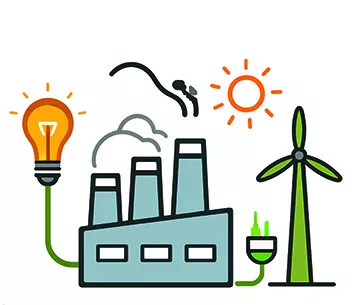
Focusing on energy optimisation across operations, electrification of equipment and processes, and the transition to renewable energy sources.
Examples:
- Replacing diesel-powered equipment with electric alternatives at production sites
- Optimising energy consumption in manufacturing processes (e.g. blasting, mixing, heating)
- Switching to renewable electricity contracts or on-site energy production
OPERATIONS & MOBILITY TRANSFORMATION
Addressing process optimisation, industrial efficiency and the reduction of fuel consumption across operations and logistics.
Examples:
- Optimising drilling and blasting operations to reduce energy and material intensity
- Reducing fuel consumption through fleet optimisation and logistics planning
- Improving transport efficiency through route optimisation and load management
VALUE CHAIN & PRODUCT EVOLUTION

Targeting supplier engagement, material optimisation and the development and scaling of low-carbon product solutions.
Examples:
- Working with suppliers to reduce emissions linked to raw materials (e.g. explosives inputs, chemicals)
- Replacing diesel-powered equipment with electric alternatives at production sites
- Substituting high-materials with lowercarbon lower-carbon alternatives where feasible manufacturing processes (e.g. blasting, mixing, heating)
- Developing low-carbon product formulations and ensuring their availability at scale